Tell me about a mistake you made and what you learned from it
Answer "Tell me about a mistake you made and what you learned" by naming one real professional error, taking full ownership, and describing the specific change it produced in how you work. The recruiter is testing self-awareness and growth, not punishing imperfection. A confident, honest answer beats a sanitised non-answer every time.
"Tell me about a time you failed" — and its close variant, "Tell me about a mistake you made and what you learned from it" — is the interview question most candidates dread. The dread is understandable. You have spent weeks polishing your CV and building the case for why you are the ideal candidate. Now someone is explicitly asking you to talk about a failure. The question is not a trap. It is one of the clearest windows into your self-awareness, maturity, and growth orientation. Many hiring managers say a candidate's answer to a failure question reveals more about long-term potential than any other question in the interview. This guide shows you how to make it work for you.
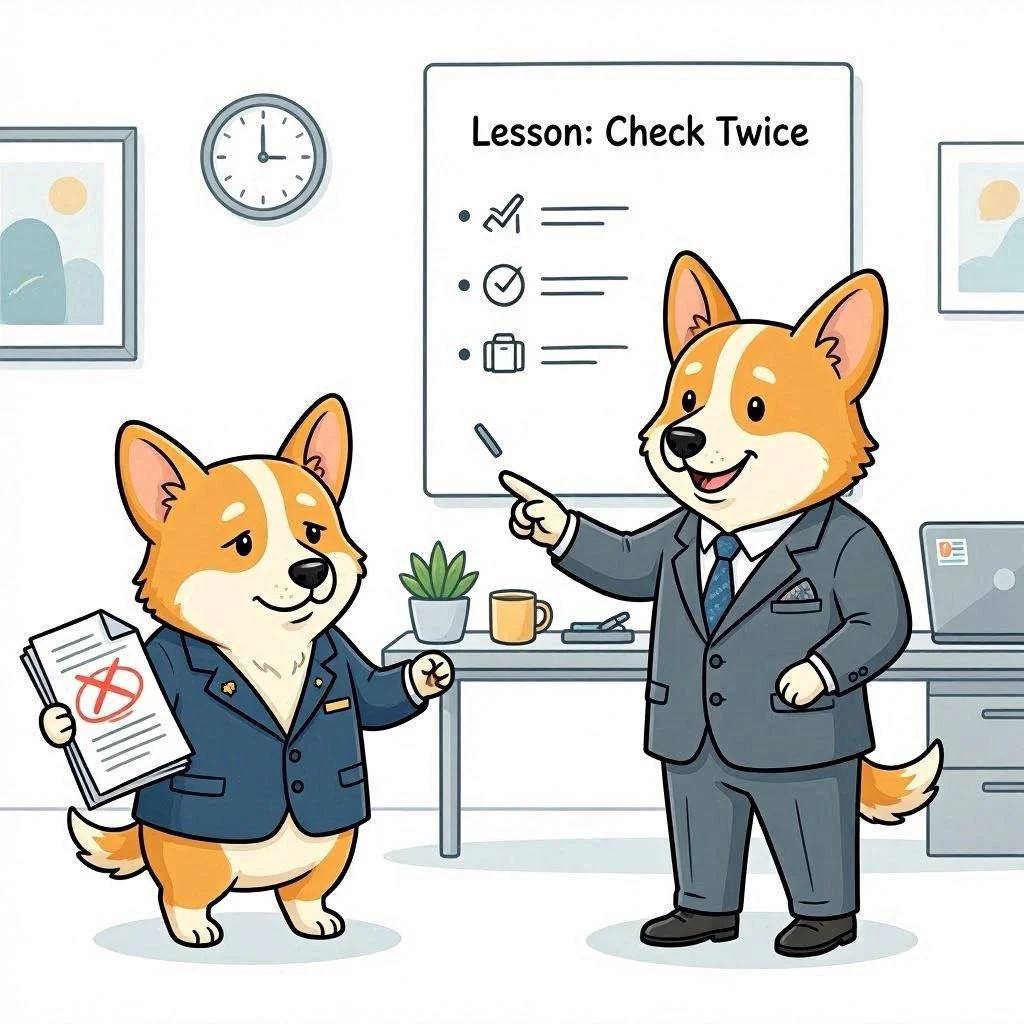
What the question is actually measuring
The mistake question measures four traits at once: accountability, self-awareness, your real-time response to failure, and concrete learning. Recruiters and hiring managers assess all four from a single story.
Accountability and ownership: Do you take personal responsibility when things go wrong, or do you diffuse blame onto circumstances, colleagues, or bad luck? Candidates who immediately explain how "the situation was difficult" or "the team let me down" signal that they will not learn from adversity — and that working with them when things go wrong could be frustrating.
Self-awareness: Do you have an accurate understanding of your own weaknesses and blind spots? Can you identify specifically what you did (or failed to do) that contributed to the outcome?
Constructive response to failure: Did you address the problem proactively, communicate clearly, and make things as right as possible? Recruiters are often less interested in the mistake than in how you handled it in real time.
Growth and learning: What did you concretely change as a result? Saying "I learned to communicate better" is too vague. "I implemented weekly written status updates with the client after realising they needed more frequent touchpoints than I had assumed" is a learning that is specific, actionable, and credible.
Choosing the right mistake to discuss
Choose a genuine professional error with real consequences that you owned and recovered from. Most candidates go wrong here. They pick an example that is too trivial (signalling low self-awareness or reluctance to be honest) or one so serious it raises real doubts about their competence.
Too trivial: "I once sent an email to the wrong distribution list." This signals that you cannot distinguish between a genuine professional mistake and a minor administrative error.
Too serious: "I made a data entry error that cost the company £200,000 and nearly got us sued." Without an exceptional recovery story, this plants doubts that are hard to erase.
The ideal mistake sits in the middle: a genuine professional error with real consequences, where you took clear ownership, managed the situation well, and demonstrably changed your behaviour as a result.
Pro tip
The best examples often involve a judgment error rather than a technical one — situations where you misjudged timelines, underestimated complexity, misread a client or stakeholder relationship, or failed to communicate proactively. These examples feel authentic, show self-awareness, and lend themselves to credible learning outcomes.
The Epimoni SARL structure for the mistake question
The Epimoni SARL structure adapts the standard STAR method for failure questions: it replaces Result with Learning and adds a dedicated real-time response step. The four parts are Situation, Action, Response, Learning.
- Situation: Briefly set the scene — what project, what context, what was at stake.
- Action (or inaction): What specifically did you do — or fail to do — that led to the mistake? Take personal ownership here. Be specific.
- Response: How did you handle the situation once you realised the error? What steps did you take to address the consequences?
- Learning: What did you concretely change in your behaviour, process, or approach as a direct result? How has this made you more effective since then?
Watch out
Do not minimise the mistake in your Situation section and then overclaim the lesson in your Learning section. The proportionality has to feel genuine. If the mistake was genuinely small, the lesson cannot be profound. Choose a real mistake and be honest about its impact.
Worked examples: UK and US scenarios
UK scenario: Marketing manager at a London media company
Laura is applying for a Head of Marketing role. She uses a failure from her third year in the industry.
"About three years ago, I led the launch campaign for a new subscription product. I was confident in the creative concept and felt the brief was clear, so I moved into production without running a formal review with the commercial team. The campaign launched with messaging that, while accurate, significantly undersold a key differentiating feature that the sales team relied on heavily. We saw a healthy click-through rate but a 40% lower conversion rate than projected, and it took us six weeks and a revised campaign to recover — at an additional cost of around £35,000.
As soon as I understood the disconnect, I went to the commercial director, took full responsibility, and committed to a revised timeline. We rebuilt the campaign collaboratively rather than in silos.
The concrete lesson was about the cost of assumed alignment. I had believed the brief was clear because I had written it. Since then, I run a structured pre-launch review for every major campaign that includes at minimum the commercial, product, and customer success leads — a 45-minute checkpoint that has saved us from similar disconnects at least three times since. It is now built into our campaign workflow."
US scenario: Product manager at a SaaS startup in Austin
Jason is applying for a Director of Product role.
"Two years ago, I pushed hard to ship a feature in sprint despite our QA lead flagging incomplete test coverage. My reasoning was that the feature was low-risk and the client deadline was real. I was wrong — a bug in an edge case caused data sync failures for about 8% of users over a 36-hour period before we rolled back. We lost the trust of two enterprise accounts who experienced the issue, and one of them ultimately churned at renewal.
When the issue surfaced, I drafted the customer communications myself, briefed the support team within an hour, and stayed in direct contact with both affected accounts to explain what had happened and what we were doing. One of those accounts stayed; one did not.
What I changed was my relationship with the definition of 'done.' I had been treating QA as a gate to manage around when convenient. I rebuilt our engineering team's pre-release checklist with the QA lead, and I personally review the open test coverage against risk level before any ship decision. In the eighteen months since, we have not had a single customer-impacting regression. I also credit that experience with making me a stronger advocate for QA resource in planning conversations — I now have the data to argue for it."
UK vs US cultural differences for this question
The norms around discussing failure differ meaningfully between British and American interview culture: UK candidates should stay composed and analytical, while US candidates can show more authentic vulnerability.
In the UK, particularly in professions like banking, law, consulting, and the public sector, there is a cultural premium on stoicism and measured self-presentation. Admitting a major failure too freely can be read as a lack of discretion or professionalism. UK candidates are expected to show self-awareness, but in a composed, analytical way — not a confessional one. The tone should be reflective and controlled: "I identified what went wrong, I took responsibility, I changed my approach."
British competency-based interview frameworks — used widely in organisations that run structured hiring through Workday — often include specific probes like "What would you do differently?" and "How did you ensure this would not happen again?" Be prepared with crisp, specific answers to both.
In the US, there is a stronger cultural expectation of authenticity and vulnerability in professional settings. American interviewers at growth-stage companies and tech firms often respond well to candidates who can tell a genuinely honest failure story with emotional honesty alongside professional reflection. The ideal balance in a US context is: be real about the failure, be direct about taking ownership, and be energetic about the growth. Excessive British understatement can read as evasiveness.
In both markets: honesty is more valued than polish. A clearly rehearsed, slightly sanitised answer that does not feel like a real mistake will be spotted immediately. Choose an example you actually lived and can speak about fluently.
Watch out
Avoid the cliché of framing your mistake as secretly a strength: "My biggest mistake is that I care too much" or "I pushed myself too hard." This is so widely mocked — it has become a meme — that interviewers will immediately discount your answer and mark you down for trying to dodge the question. Choose a real mistake.
Common pitfalls to avoid
Avoid four traps with the mistake question: blaming external factors, choosing a vague lesson, skipping how you responded, and over-polishing the story until it sounds contrived.
Blaming external factors. If your answer includes phrases like "the client changed the brief," "the system let us down," or "my manager had not given clear guidance," you are signalling that you do not take personal ownership of outcomes. Even in situations where others contributed to the problem, your answer should focus on your role and your response.
Choosing a vague or unhelpful lesson. "I learned that communication is important" is not a lesson — it is a truism. A lesson must be specific and actionable: what do you do differently now, concretely?
Failing to complete the story. Some candidates describe the mistake and the learning but skip over what they did to address the immediate consequences. That gap matters: how you responded in the moment tells the recruiter as much about your character as the lesson you took away.
Overchoosing the example. Some candidates research extensively and try to present a polished, impressive failure story that demonstrates their high ambitions and thoughtful character. This often feels contrived. The best answers are about genuine, human mistakes — the kind every professional makes — handled with grace and intelligence.
FAQ
Which mistake should I choose for this question? Choose a genuine professional error with real but recoverable consequences — usually a judgment error such as misjudging a timeline, underestimating complexity, or failing to communicate proactively. Avoid trivial admin slips and avoid catastrophic errors that raise competence doubts. The best mistake is one you owned, fixed, and changed your behaviour over.
Can I say I have never made a significant mistake? No. Claiming you have never made a mistake signals either low self-awareness or evasiveness, and recruiters read it as a red flag. Every experienced professional has made mistakes. Naming a real one and showing growth is far more credible than denial.
Should the lesson be technical or behavioural? Behavioural and judgment lessons tend to land best because they apply across roles and feel authentic. State a specific change: a new pre-launch review, a written status-update cadence, or a stricter definition of "done". A concrete process change beats a vague "I learned to communicate better".
How long should my answer be? Aim for 90 seconds to two minutes. Spend most of the time on your Response and Learning, not on describing the mistake itself. Recruiters care more about how you recovered and what you changed than about the error.
Practice your answer now
Ready to test yourself? Use our AI interview simulator to get instant feedback on your answer to this question.
This question pairs naturally with the problem-solving question. For a guide to structuring complex problem answers using the full STAR method, see how to answer "Tell me about a situation where you solved a complex problem". If you want to strengthen your overall interview preparation, our guide on how to manage stress before and during an interview covers the mindset and practical techniques that make answers like this land naturally rather than nervously.
Put it into practice
Apply the advice from this article with the free Epimoni tool: Start the interview simulator